

Article
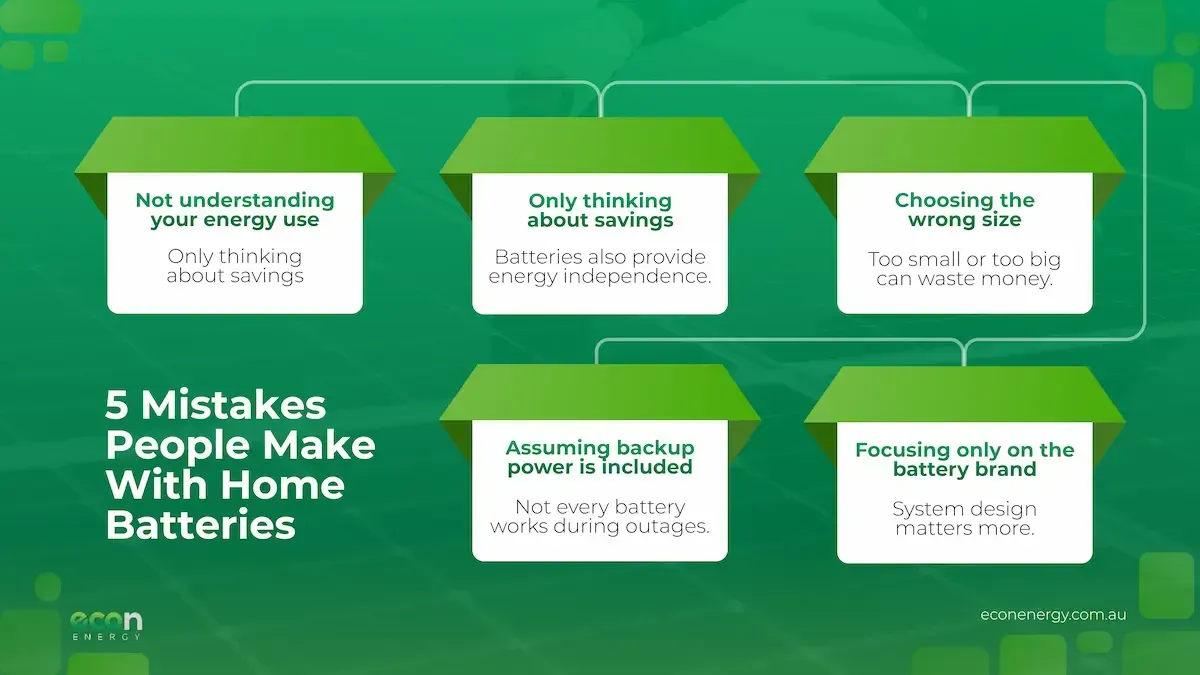
The Biggest Mistakes Homeowners Make When Choosing a Battery
Summary: The federal battery rebate has made home batteries more accessible than ever, but rushing into a purchase without the right information can cost you significantly more in the long run. From buying the wrong size to ignoring warranty fine print, the mistakes homeowners make at the quoting stage are often the most expensive. This guide walks you through the most common pitfalls so you can make a confident, informed decision.
Home batteries are selling like crazy right now. The federal rebate kicked in July 2025, knocking roughly 30 per cent off the price, and suddenly everyone wants one.
Problem is, most people are making expensive mistakes before they even get a quote.
Here are the ones that cost you the most.
Buying the wrong size battery
This is the big one. And it goes both ways.
An oversized battery sounds great in theory. More storage, more savings, right? Not if your solar system can't fill it. A 20 kWh battery paired with a 5 kW solar array will sit half-empty most days, especially in winter when solar output drops significantly. You're paying for storage you'll never use.
On the flip side, an undersized battery cycles too hard, wears out faster, and won't cover your overnight usage.
The rough guide is this: your battery capacity should match about 60 to 80 per cent of your solar system's daily output. For a standard 6.6 kW system, that's an 8 to 12 kWh battery. For a 10 kW system, you're looking at 12 to 15 kWh.
Most Australian homes use 16 to 18 kWh per day, with around 7 to 8 kWh of that happening overnight. A 10 to 13 kWh battery handles most households just fine.
And think ahead. Getting an EV? That's another 7 to 15 kWh of daily demand. Switching from gas to a heat pump? More load again. Modular systems from brands like BYD, Sungrow, and Alpha ESS let you start right-sized and expand later. If you're not sure what size suits your home, our battery storage options page breaks down the most common configurations for Australian households.
Confusing capacity with power output
Here's where people get properly tripped up. Energy capacity (measured in kWh) tells you how much a battery stores. Power output (measured in kW) tells you how much it can deliver at once.
A 13.5 kWh battery with a 5 kW continuous output can't run your air con (3.5 kW) and oven (2.5 kW) at the same time. Doesn't matter how much energy is stored. It's like having a full water tank with a tiny tap.
Always check both numbers before you buy.
Picking the wrong installer
This one can bite you hard. Since the rebate launched, new companies have popped up everywhere. Some are great. Some registered their ABN five minutes after the government announced the program.
CHOICE Australia flags several red flags to watch for: door knockers claiming the rebate is about to expire (it steps down gradually through 2030), 'no-interest finance' where the interest is just baked into an inflated system price, and companies using AI-generated ads with unrealistic savings claims.
Your installer must be accredited by Solar Accreditation Australia (SAA), which replaced CEC accreditation in May 2024. Using a non-accredited installer can void your warranty, mess up your insurance, and create genuine safety risks. Lithium-ion batteries contain flammable compounds. Poor installation can lead to serious problems.
Get at least three quotes. Check the company's track record. Ask for references. You need to look beyond the bottom-line price, the same way you would with any major home investment.
Assuming every battery does blackout backup
This catches a lot of people off guard. Not every battery keeps the lights on when the grid goes down. And even those that do have limitations.
There are two levels of backup. Basic backup runs your home from stored energy only, but your solar panels shut down when the grid fails. Full backup keeps both the battery and panels running during outages, giving you power as long as the sun is shining.
SolarQuotes has documented cases of homeowners finding out their system doesn't charge from solar during blackouts. One person described being 'stunned' that their system went dead while their panels sat idle in full sun.
Before you sign anything, get it in writing: how many circuits will the battery back up, and will your solar panels charge the battery without the grid? Our battery storage services page explains exactly how we design backup systems so there are no surprises after installation.
Chasing the cheapest price
The sticker price tells you almost nothing useful. A $10,000 battery lasting 10 years costs you $1,000 a year. A $12,000 battery lasting 15 to 20 years costs $600 to $800 a year. The 'expensive' one is actually 20 to 40 per cent cheaper over its lifetime.
The metric that matters is Levelised Cost of Storage (LCOS), which is basically the total cost divided by total energy delivered over the battery's life. Right now, Sungrow's SBR HV sits around $0.18 per kWh. Tesla Powerwall 3 is around $0.31 per kWh. That gap is massive over 10 to 15 years.
Also worth knowing: bigger batteries are dramatically cheaper per kWh because fixed costs get spread across more storage. A 5 kWh system runs about $1,600 per kWh installed. A 10 kWh system drops to $800 to $1,000 per kWh.
Ignoring the warranty fine print
Battery warranties have three independent limits, and whichever one you hit first ends your coverage: calendar life (typically 10 years), cycle limits (usually 5,000 to 10,000 cycles), and throughput (total energy delivered in megawatt-hours).
Throughput is the sneaky one. Heavy use or aggressive daily cycling eats through it faster than you'd expect.
A few other traps to watch. Tesla drops its warranty from 10 years to 4 if the system isn't connected to the internet and registered on their app. Several brands void warranties for coastal installations. Bluetti prohibits outdoor installation within 2 km of the coast. Given 85 per cent of Australians live near the coast, that's a big deal.
BYD only guarantees 60 per cent capacity retention at warranty end compared to the industry standard of 70 per cent. On a 13.8 kWh system, that means potentially just 8.3 kWh of usable storage by the time the warranty runs out.
Getting the rebate maths wrong
The federal Cheaper Home Batteries Program is genuinely generous, roughly 30 per cent off at the point of sale. But the structure is changing from May 2026, with tiered rates that penalise oversizing. The first 14 kWh gets the full rate. After that, you get less per kWh.
State programs vary too. Western Australia offers the best stacking opportunity with up to $1,300 state rebate plus interest-free loans up to $10,000 on top of the federal rebate. Most other states have wound down their own battery programs.
Real-world payback periods range from about 6 years in Adelaide to over 20 years in Hobart. Adelaide leads because South Australian electricity is the most expensive in the country. Hobart trails because Tasmanian electricity is cheap and feed-in tariffs are relatively generous.
Common calculation mistakes include blending solar and battery savings together (always separate them), ignoring degradation, assuming you'll fully cycle the battery every single day, and projecting unrealistic electricity price increases.
Not thinking about where you put it
Australia's climate punishes batteries. A battery mounted on a north or west-facing wall in direct sun can lose 2 to 3 years of useful life. Garages regularly hit 50°C in summer.
The fix is simple: install on a shaded south or east-facing wall, or inside an insulated garage. It's one of the cheapest decisions you'll make with the biggest impact on battery life.
Coastal? Check the IP rating. You need IP66 or higher for tropical or coastal areas, and make sure your chosen brand doesn't have a coastal warranty exclusion.

The bottom line
A home battery is a solid investment in the right circumstances. In Adelaide, Perth, Brisbane, and Sydney, payback of 6 to 8 years is realistic with the current rebate. In Melbourne and Hobart, the economics are tighter.
The difference between a good battery investment and a bad one comes down to three things: sizing it to your actual consumption, choosing a reputable SAA-accredited installer, and comparing lifecycle cost per kWh rather than sticker price. If you're also considering whether your existing solar system is compatible with battery storage, that's worth checking before you commit to any particular battery brand.
Get those three right and you'll be in good shape.
Frequently Asked questions
What size battery do I need for my home?
As a rough guide, your battery capacity should match 60 to 80 per cent of your solar system's daily output. For a standard 6.6 kW solar system, that's usually an 8 to 12 kWh battery. Your actual usage patterns and any future additions like an EV will also affect the right size for your home.
Will my battery keep the power on during a blackout?
Not automatically. Some batteries provide basic backup using stored energy only, while others offer full backup that keeps both the battery and solar panels running during an outage. Always confirm in writing what your system will and won't do during a blackout before signing anything.
What's the difference between battery capacity and power output?
Capacity (kWh) is how much energy the battery stores. Power output (kW) is how much it can deliver at once. A battery with high capacity but low power output may not be able to run multiple appliances simultaneously, even if it's fully charged.
How do I know if my installer is reputable?
Check that they're accredited by Solar Accreditation Australia (SAA). Get at least three quotes, ask for references from previous jobs, and be wary of door knockers or companies offering deals that feel rushed or too good to be true.
Is the federal battery rebate still available?
Yes, the Cheaper Home Batteries Program is currently active, offering roughly 30 per cent off at the point of sale. The structure is changing from May 2026 with tiered rates, so it's worth understanding how the rebate applies to the system size you're considering.
Does where I install the battery matter?
Significantly. Batteries installed in direct sun or in hot garages can lose years of useful life. A shaded south or east-facing wall, or an insulated garage, is the best option for most Australian homes.
What should I check in the warranty?
Look for three things: calendar life, cycle limits, and throughput. Whichever limit you hit first ends your coverage. Also check whether your brand has coastal exclusions or connectivity requirements that could affect your warranty.
How do I calculate the real cost of a battery?
Rather than looking at the sticker price, look at the Levelised Cost of Storage (LCOS), which is the total cost divided by total energy delivered over the battery's life. This gives you a much more accurate comparison between different brands and sizes.
share this
Related Articles
Related Articles
GET IN TOUCH
Want to learn More?
Contact our friendly team at Econ Energy and we will get back to you as soon as possible!